Rent vs. Own in Las Vegas: Why the Monthly Payment Is Only Part of the Story
Posted: October 01, 2026 by John McClelland
Rent vs. Own in Las Vegas: Why the Monthly Payment Is Only Part of the Story
For many Las Vegas renters considering homeownership, the first comparison is simple:
“What am I paying in rent versus what would my mortgage payment be?”
That is an important question, but it is not the whole financial picture.
At Dovetail at Decatur, a four-bedroom townhome provides a useful real-world example of why buyers should look beyond the headline monthly payment and consider what they may receive in return: principal reduction, potential tax benefits, greater housing-cost stability and the opportunity to build long-term equity.
The Dovetail Example
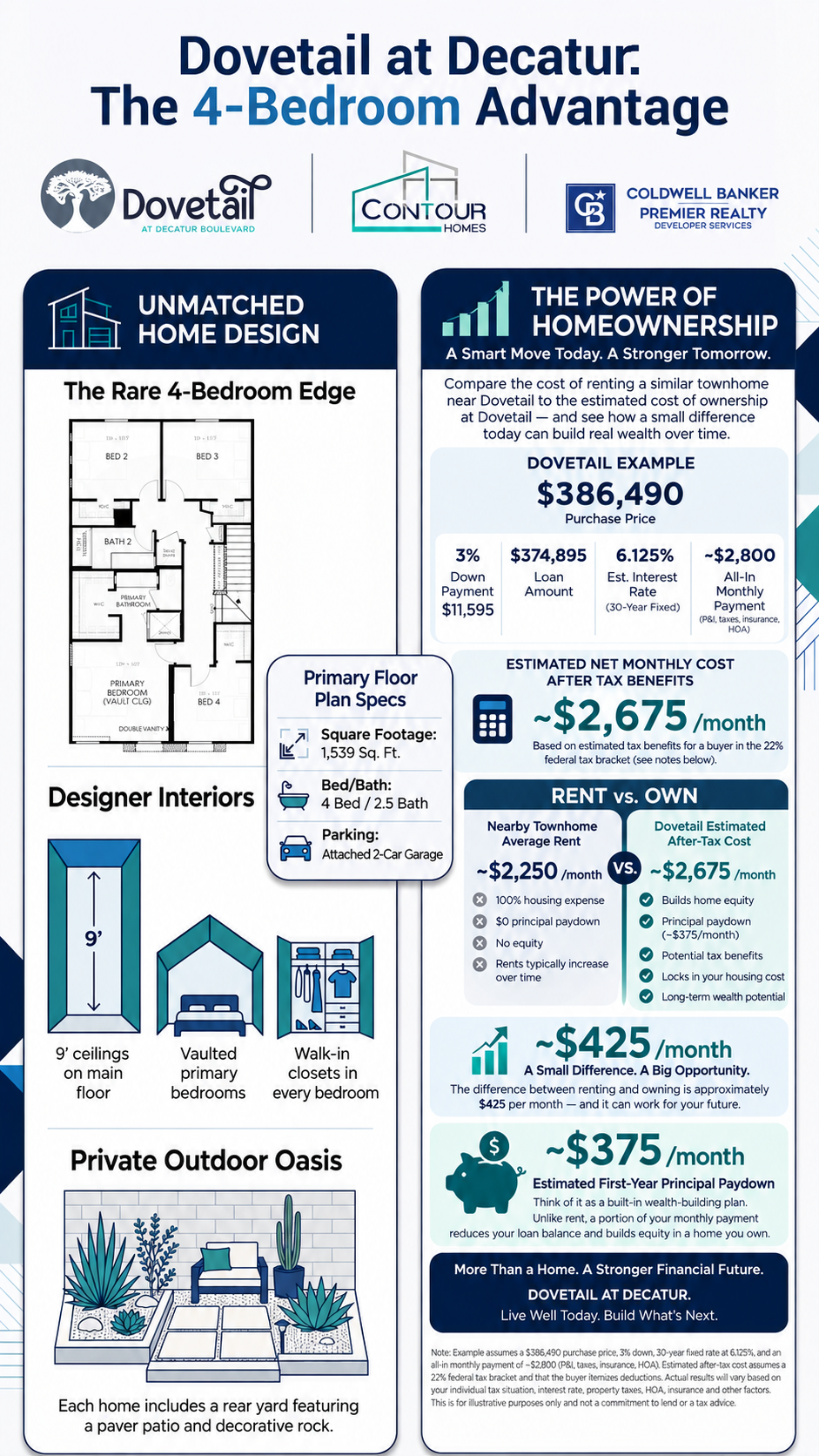
Consider a Dovetail townhome priced at $386,490.
Using a hypothetical financing scenario of:
- 3% down: approximately $11,595
- Loan amount: approximately $374,895
- Estimated interest rate: 6.125% on a 30-year fixed mortgage
- Estimated all-in monthly payment: approximately $2,800, including principal, interest, property taxes, insurance, and HOA
Now compare that with approximately $2,250 per month to rent a similar townhome nearby.
At first glance, renting appears to cost less each month.
But that comparison changes when you look at what happens to the money after the payment is made.
Rent Is an Expense. A Mortgage Can Also Build Equity.
With rent, the monthly payment provides housing, but the renter does not receive principal reduction or ownership equity from those payments.
With homeownership, a portion of each mortgage payment reduces the outstanding loan balance.
In the Dovetail example, approximately $375 per month during the first year is estimated to go toward principal reduction.
That equates to roughly:
$4,500 of potential equity accumulation during the first year alone.
This is one reason homeownership can function as a form of forced savings. Instead of the entire monthly housing payment being consumed as an expense, a portion is systematically converted into ownership equity.
As the years progress on a traditional fixed-rate mortgage, the principal portion of the payment generally increases, meaning an even greater share of the payment can go toward reducing the loan balance.
What About the Tax Benefits of Homeownership?
Homeowners may also benefit from federal income-tax deductions for mortgage interest and property taxes, depending on their individual tax situation and whether they itemize deductions.
Using the assumptions reflected in the accompanying infographic, the estimated after-tax monthly housing cost is approximately $2,675.
That puts the difference between nearby rent and the estimated after-tax ownership cost at approximately: $425 per month
That $425 difference should not necessarily be viewed as simply an additional housing expense.
Approximately $375 per month in the first year is estimated to be reducing the homeowner’s mortgage balance.
That changes the conversation.
Rather than asking only:
“Is owning more expensive than renting?”
A more meaningful question may be:
“What am I receiving for the additional monthly investment?”
The Bigger Financial Message
Even with the monthly delta between renting and owning, and even in a higher interest-rate environment, there is an important financial message that should not get lost.
For many households, real estate remains one of the most powerful everyday forced-savings and long-term wealth-building vehicles available, particularly outside of an employer-matched 401(k).
That is because homeownership does something most monthly expenses do not: it can convert a portion of what you spend every month into an asset you own.
Every principal payment reduces the mortgage balance and increases the homeowner’s equity. Over time, that forced-savings component may be compounded by potential home-price appreciation, while a fixed-rate mortgage can provide greater predictability for the principal-and-interest portion of the payment.
This does not mean buying is automatically the right financial decision for every household. Interest rates, purchase price, expected length of ownership, maintenance costs, available savings, and personal financial circumstances all matter.
But the conversation should extend beyond:
“Is the mortgage payment higher than my rent?”
The more important question may be:
“Where will I be financially five, ten or twenty years from now if I continue renting versus systematically building equity through homeownership?”
That is the message illustrated by the Dovetail example.
The approximately $425 monthly difference between estimated rent and estimated after-tax ownership cost is not simply an additional expense. Approximately $375 per month in the first year is estimated to be reducing principal and building equity.
In other words, a significant portion of that monthly difference may be working toward the homeowner’s future rather than simply paying for today’s housing.
The Long-Term Power of Ownership
Homeownership can potentially create wealth through several different mechanisms.
Principal reduction steadily increases the homeowner’s ownership position as the loan balance declines.
Potential appreciation may increase the value of the property over time, although appreciation is never guaranteed.
A fixed-rate mortgage can provide greater predictability for the principal-and-interest portion of the housing payment compared with rent, which may increase over time.
And perhaps most importantly, homeownership creates an asset. A renter may spend hundreds of thousands of dollars on housing over a decade without accumulating ownership in the property. A homeowner making payments over that same period is gradually acquiring a larger ownership stake in the home.
That distinction can become increasingly meaningful over time.
Dovetail’s 4-Bedroom Advantage
The financial comparison is only one side of the equation.
Dovetail at Decatur was designed to provide something difficult to find at this price point in the Las Vegas market: a highly functional four-bedroom townhome with features typically associated with larger homes.
The approximately 1,539-square-foot floor plan includes four bedrooms, 2½ bathrooms and an attached two-car garage.
Homeowners also benefit from:
- 9-foot ceilings on the main floor
- Vaulted primary bedroom ceilings
- Walk-in closets in every bedroom
- Designer-inspired interiors
- A private rear yard
- Paver patio and decorative rock landscaping
For households comparing apartments, rental townhomes, and entry-level ownership opportunities, that combination of space, privacy and functionality can materially change the value equation.
Don’t Compare Rent and Mortgage Payments in a Vacuum
There are legitimate reasons why renting may be the right choice for some households. Flexibility, expected length of residence, available savings, maintenance responsibility, and broader financial goals should all be considered.
But buyers should also be careful not to make a long-term financial decision based solely on the difference between a rent payment and a mortgage payment.
Homeownership introduces something rent cannot:
the opportunity to turn part of your monthly housing expense into an asset you own.
For a household that is financially prepared for homeownership and plans to remain in the home long enough, that distinction can become one of the most important components of long-term wealth creation.
Live Well Today. Build What’s Next.
At Dovetail at Decatur, the goal is more than providing another place to live. It is creating a home that combines thoughtful design, usable space, private outdoor living, and the potential financial benefits of ownership.
For Las Vegas renters who have assumed homeownership is financially out of reach, it may be worth taking a closer look at the numbers.
The difference between renting and owning may be smaller—and financially more meaningful—than it first appears. Even when ownership costs more each month, the important question is not simply what you spend today, but what that spending can help build for tomorrow.
Illustrations are for informational purposes only and are not a commitment to lend. Financing assumptions, interest rates, payments, taxes, insurance, HOA fees and closing costs may change. Estimated tax benefits depend on individual circumstances and whether a taxpayer itemizes deductions. Consult a qualified lender and tax professional regarding your specific situation. Home values and appreciation are not guaranteed.